THOUSANDS OF FREE BLOGGER TEMPLATES
testing

Rabu, 26 Mei 2010

[uNGu]™ Fish : Targetfish (Terapon jarbua)


Targetfish
Targetfish
Species Terapon jarbua
Family Terapontidae
Difficulty Moderate
Min. Tank Size 250 US Gallons (946.4L)
Size 30-36 cm (11.8-14.2")
sg 1.002 - 1.025
pH 7.8 - 8.2
Temp. 24 -28 °C (75.2-82.4°F)
Water Hardness 8-12 °d
Stocking Ratio 1:2 M:F
Availability Uncommon
Diet Omnivore
Pellet Foods
Flake Foods
Live Foods
Other (See article)
Life Span 5-10 years
Habitat Indo-Pacific


Alternative names

Targetfish, Thornfish, Crescent Grunter, Crescent Perch, Crescent-Banded Grunter, Crescent-Banded Tigerfish, Jarbua, Jarbua Terapon, Spiky Trumpeter, Squeaking Perch, Threestripe Tigerfish, Tiger Perch

[edit] Sexing

Unknown

[edit] Tank compatibility

Should only be mixed with large brackish fish, such as Monodactylus and Toxotes. Caution should be taken even with large fish because they are scale nippers and do extensive, but not deadly damage to broad bodied non-aggressive fish like Scats.

[edit] Diet

In the wild, feeds on fish, invertebrates, and detritus, but will accept pellets in captivity.

[edit] Feeding regime

Once or twice a day on dry foods and frozen foods, every other day on meaty foods.

[edit] Environment Specifics

Keep in brackish water, SG around 1.002 to 1.007; and hard, alkaline water. Temperature around 24-28°C (75.2-82.4°F) . The SG can go to full seawater strength up to 1.025.

[edit] Behaviour

May be predatory towards smaller tank mates, as well as occasional nipping of other fish. Will eat fish 1/4 to 1/3 their size!

[edit] Identification

Mostly silver, with almost curved bands running horizontally across the sides; looking like an archery target from above. Tail banded with black. Large, sharp dorsal fins. Not to be confused with Terapon theraps, which has completely straight lines across the flanks. 

[uNGu]™ Fish : Terapon Species (Saltwater to Freshwater)

This is a post about the teraponids. Teraponids or the family teraponidae have a lot of species, most of them are marine and brackish species but majority of the brackish dwelling teraponids can live well in a freshwater aquarium.


The Terapon jarbua is very common in the shores, estuarines and rivers anywhere in the Philippines. You can see them in schools and are fast swimmers which proved difficult to catch especially the juveniles. I was able to catch them when i spent a night at EL Salvador, they were resting so i got a chance to catch a few with my bare hands with the help of a rechargeable flashlight for me to see. Abruptly transfering the Terapon jarbua from a saltwater to a freshwater setup will do them no harm.

Click here to see a large version

COMMON NAME:
Target fish, Crescent perch and Crescent grunter

SCIENTIFIC NAME:
Terapon jarbua

MANALILI/MAGALLANES NAME:
None - i have seen one vendor selling this fish once.

LOCAL NAME:
Kanigit, Bagaong kambang, Bagaw, Balauling, Banlaongan, Baraungan, Bigaong, Buga-ong, Bungao, Bungkaong, Gunggong,Langaat, Mayavayawong, Tutot

ORIGIN:
Red Sea and East Africa to Samoa, north to southern Japan, The PHILIPPINES, Australia, and Lord Howe Island.

SIZE:
36.0 cm


Click here to see a large version

COMMON NAME:
Largescaled terapon

SCIENTIFIC NAME:
Terapon theraps

MANALILI/MAGALLANES NAME:
None

LOCAL NAME:
Kanigit, Bagaong kambang, Bagaw, Balauling, Banlaongan, Baraungan, Bigaong, Buga-ong, Bungao, Bungkaong, Gunggong,Langaat, Mayavayawong, Tutot

ORIGIN:
East Africa, Madagascar, Seychelles, Red Sea, Arabian Peninsula, India, Andaman, The PHILIPPINES and northern Australia

SIZE:
30.0 cm


Click here to see a large version

COMMON NAME:
Smallscaled terapon

SICENTIFIC NAME:
Terapon Puta

MANALILI/MAGALLANES NAME:
None

LOCALNAME:
Kanigit, Bagaong kambang, Bagaw, Balauling, Banlaongan, Baraungan, Bigaong, Buga-ong, Bungao, Bungkaong, Gunggong,Langaat, Mayavayawong, Tutot

ORIGIN:
India, Australia and The PHILIPPINES

SIZE:
16.0 cm


Click here to see a large version

COMMON NAME:
Six-lined trumpeter

SCIENTIFIC NAME:
Terapon Pelates sexlineatus

MANALILI/MAGALLANES NAME:
None

LOCAL NAME:
Kanigit, Bagaong kambang, Bagaw, Balauling, Banlaongan, Baraungan, Bigaong, Buga-ong, Bungao, Bungkaong, Gunggong,Langaat, Mayavayawong, Tutot

ORIGIN:
Taiwan, Australia, Papua New Guinea and The PHILIPPINES

SIZE:
15.0 cm


The information below applies to the Terapon jarbua and it may or may not apply to the rest of the species in this post.

DIET:
Mainly livefoods but can be trained to eat meat based pellets to standard fishfoods.

NOTE:
In an aquarium setup, it is best to keep terapons with nimble and agile tankmates due to the fact that teraponids can become nippy towards other tankmates. Behaviours may vary among individuals.

Kamis, 13 Mei 2010

[uNGu]™ Fish : Kryptopterus bicirrhis - Glass Catfish


Kryptopterus bicirrhis, Valenciennes, 1839

Origin:Thailand, Malaysia and Indonesia(Sumatra, Java and Borneo).
Etymology: unk.
Synonyms: Cryptopterichthys bicirrhis, Cryptopterus amboiensis, Kryptopterichthys palembangensis, Silurus bicirrhis, Silurus palembangensis.
First European import: Germany, 1934, by Winkelmann.
Description: See picture(s).
Care: These fish are best kept in larger tanks in groups of 6 or more. This way they will display much of their natural behaviour, which is very intersting to observe. Kryptopteris bicirrhis requires current, and free swimming space, combined with some form of shelter(floating plants, large leaves)underneath which they will stand. As the fish are somewhat sensitive, frequent waterchanges with pre-treated water are required. Pretty indifferent towards watervalues, although the water shouldn't be too hard, and peat filtration can be beneficial. The fish will inhabit the middle and higher regions of a tank.
Temperature: 21-25 degrees.
Feeding: Omnivorous, all food is accepted, the food should be small.
Size: Up to 15 cm, but in aquaria usually smaller, 8-9 cm.
pH: 6.0-7.5
Breeding: Has been bred occasionally, although currently no detailed information is available. The eggs are virtually invisible, as are the fry. Usually some fry appear suddenly in community tanks.
Sexual dimorphism: Unknown.

Jumat, 07 Mei 2010

[uNGu]™ Fish : Tetraodon palembangensis - Humpback Puffer

Tetraodon palembangensis - Humpback Puffer


<I>Tetraodon palembangensis</I><I>Tetraodon palembangensis</I>
Tetraodon palembangensisTetraodon palembangensis
© JJPhoto© JJPhoto

Family

Tetraodontidae

Distribution

Thailand, Laos, Malaysia and Indonesia.

Habitat

Inhabits freshwater streams, slow-moving rivers and ponds.

Maximum Standard Length

7.8" (19.5cm).

Minimum Tank Size

Not a particularly active puffer, a single one of these can be comfortably housed in a tank measuring 48" x 12" x 12" (120cm x 30cm x 30cm) - 110 litres.

Tank Setup

This species appreciates cover as unlike some other species of predatory puffers it doesn't tend to burrow into the substrate. Pieces of driftwood, large rocks and clay flowerpots are all suitable for this. It can be kept in a planted setup without problems, although plants aren't essential. Like all puffers, it's very sensitive to deteriorating water conditions, so regular partial water changes are a must.

Temperature

75-82°F (24-28°C)

pH Range

6.8-7.6

Hardness

8-20°H

Diet

Relishes all kinds of shellfish, as well as worms and other live and frozen foods. It should be fed snails and unshelled shellfish (such as crab legs, mussels etc.) regularly, in order to maintain its sharp teeth. As with other puffers, their teeth grow continuously and become a problem for the fish if they're not kept ground down. It's sometimes a little reluctant to accept dead foods initially, but can usually be weaned onto them with a little patience. Due to its inactive nature it doesn't need daily feeding. Every other day is fine for juvenile fish, while adults require only one or two feeds a week.

Compatibility

Unsuitable for the community tank due to its piscivorous nature. It can sometimes be kept with similarly sized or larger, active species such as bigger characins or cyprinids, but the risk is always there.

Surprisingly, while best kept as a single specimen, it's not especially hostile towards its own kind and several can be maintained in a large tank as long as plenty of hiding places and visual barriers are provided. Some squabbles will inevitably occur, so do keep a close eye on proceedings if you decide on a group.

Sexual Dimorphism

Unknown.

Breeding

Has occured in aquaria, albeit very rarely. The fish is a substrate spawner, with the eggs being laid in a pre-excavated pit within a cave. After spawning the male takes care of the eggs until they hatch, at which point the adult fish should be removed. The fry can be fed brine shrimp nauplii and even bloodworm from birth. They're quite belligerent with one another so plenty of cover is required.

Notes

Puffer fish are so called as they have the ability to inflate their elastic stomachs with water or air. This is usually a response to some kind of threat, although in the aquarium many specimens appear to inflate themselves for no apparent reason. The fish becomes 2 or 3 times it's normal size, which makes the fish both big enough to scare away many potential predators, and difficult to swallow.

Many parts of the body of puffers contain the deadly neurotoxin tetrodoxin. This is the same poison found in the notorious blue-ringed octopus. When ingested in sufficient quantities, it can cause paralysis and death. As yet there is no known antitoxin and to humans it is over 1000 times deadlier than cyanide. Grotesquely, the victim usually remains conscious as he or she becomes paralysed. It's a famous delicacy in Japan, but is prepared only by highly-trained chefs, and even then many people have died from eating it.

An ambush predator, Tetraodon palembangensis is a very inactive fish, some specimens only moving when food is offered. As such it's really only suitable for the true enthusiast. Correspondingly palembangensis are not seen in the trade very often.

Sabtu, 01 Mei 2010

[uNGu]™ Fish : Threadfin rainbowfish - Iriatherina werneri

Threadfin rainbowfish - Iriatherina werneri

Threadfin rainbowfish ( common name )
Iriatherina werneri ( fish name )
  • Maximum size in aquariums (min-max): 4 - 5 cm ( 1.57 - 1.97 in )
  • pH of water: 6 - 8
  • Water hardness (dGH): 5 - 12 °N
  • Recommended temperature: 26 - 30 °C ( 78.8 - 86 °F )
  • Compatibility (temperament to it's family): peaceful (read this answer)
  • Compatibility (temperament to other fish species): peaceful (read this answer)
  • Place in the aquarium: Top levels
  • The way of breeding: Spawning
  • Fish origin: Oceania
Information about care
Food and feeding
Do not be fooled by the size of this fish’s mouth, they have a very narrow throat. Only smaller foods must be given to them, quality flake and live foods are ideal for them. If using granular foods, always use the smallest size.

Origin
They are to be found in New Guinea and North Australia.

Sexing
The males will have longer fins and be much more colorful.

Breeding
These fish need perfect water quality to spawn; large changes at a slightly coolertemperature will induce this. Use a spawning mop, as the eggs will need to be removed once they are laid. The fry will be very small, feed with Infusoria until they have grown slightly and then feed with newly hatched brine shrimp.

Lifespan
The expected life span for this fish is 3-5 years.

Short description
Due to the males having quite long fins, avoid keeping them with fin nipping fish. They require well planted tanks but with open swimming spaces at the front.

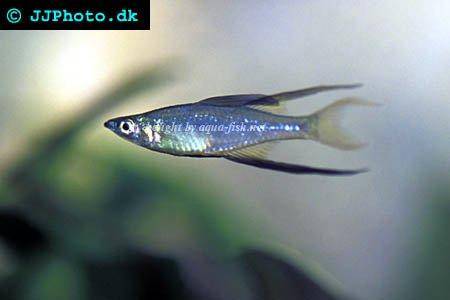
Pictures
Bought by aqua-fish.net from jjphoto.dk.
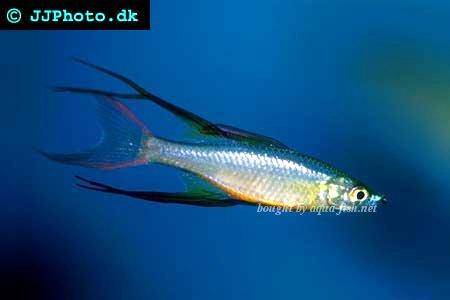
Threadfin rainbowfish, picture 1 Threadfin rainbowfish, picture 2.

Iriatherina werneri - Threadfin rainbowfish
Have this fish on your website too! Use our widget:
Iriatherina werneri
Latin Name: Iriatherina werneri;
Common Name: Threadfin rainbowfish;
Adult size is between 4 cm (1.57 inch) and 5 cm (1.97 inch);
pH should vary between 6 and 8;
dGH should be between 5 and 12;
Temperature should be between 26°C (78.8°F) and 30°C (86°F)