Chaca chaca (Hamilton, 1822)
Chaca hamiltonii Gray, 1831 - Unneeded replacement name for Platystacus chaca
Chaca lophioides Cuvier & Valenciennes, 1832 - Unneeded replacement name for Platystacus chaca
Chaca buchanani Günther, 1864 - Unneeded replacement name for Platystacus chaca

Originally described using material (not deposited in an institution) from ‘rivers and ponds of the northern parts of Bengal’, the current accepted range is India, Bangladesh, and possibly Nepal. There are reports from Myanmar, Malay, and Indonesia but these probably represent the other two species. According to Roberts (1982) the name chaca is transliterated from a Bengali name for the fish, and that this in turn derives from the sound the fish makes when it is out of water. This species reportedly reaches 19 cm SL, but I have never seen true C. chaca that size.
 Roberts rightly points out that the three species listed above were not intended to be new species, but were unneeded replacement names for Platystacus chaca, which was the name originally used by Hamilton. It was customary in practice that if a species was placed in a genus with the same name i.e. chaca into the genus Chaca, that the species name would be altered to avoid tautonomy (‘the use of the same word for the name of a genus and one of its included species‘). This was unnecessary (as per the International Code of Zoological Nomenclature) and therefore the combination Chaca chaca is valid and doesn’t need any replacement names.
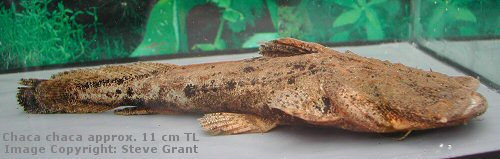
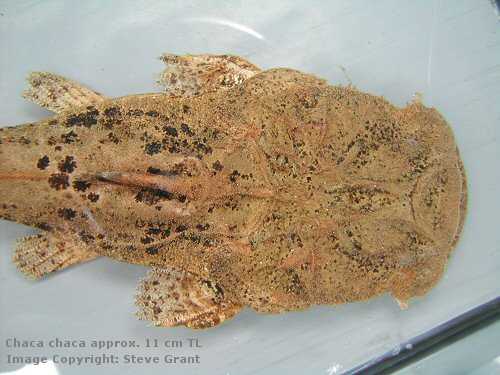
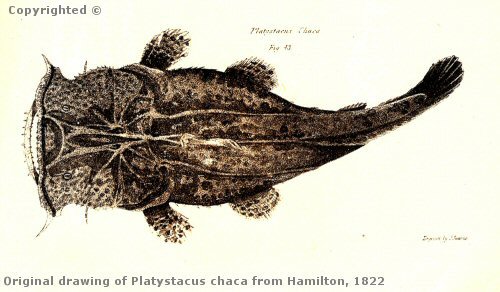
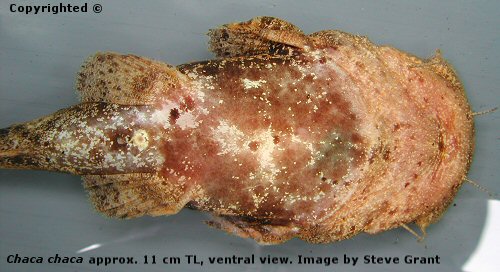
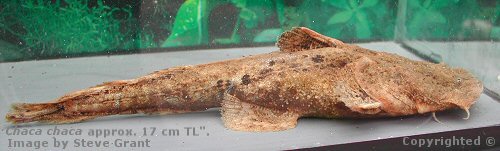
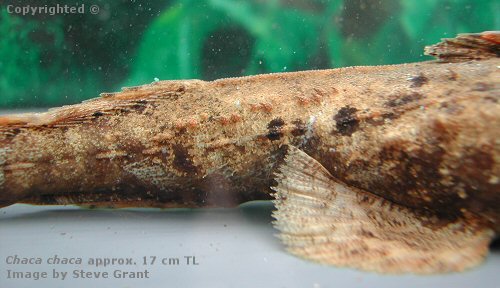
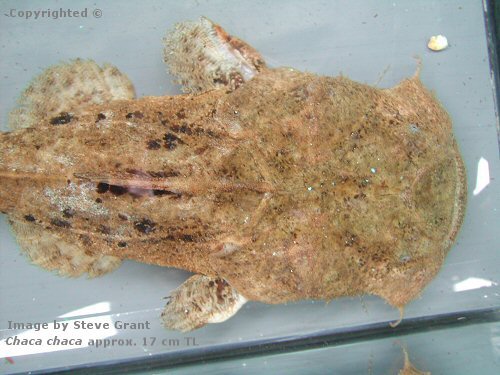
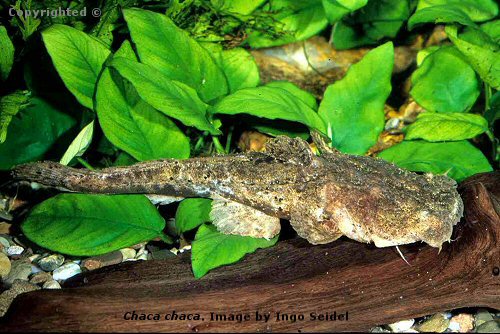
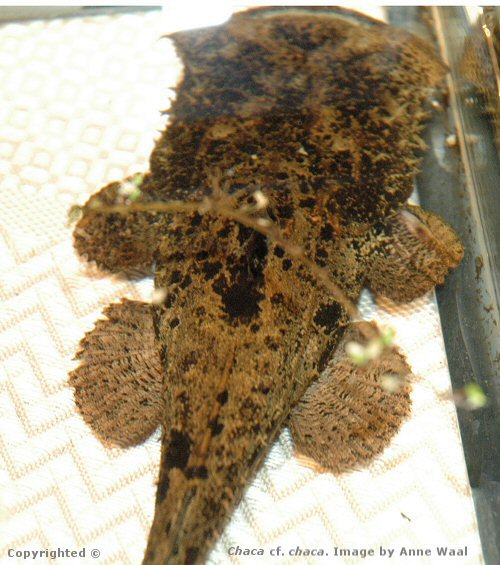
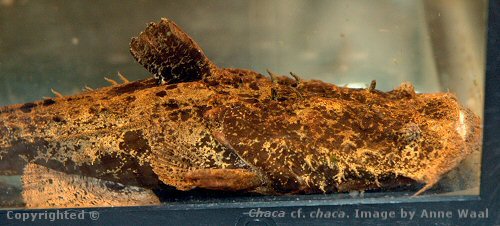
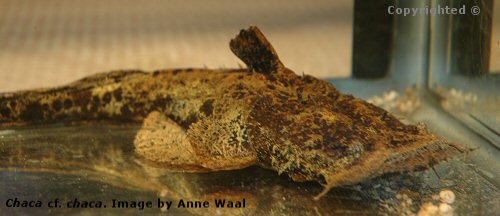
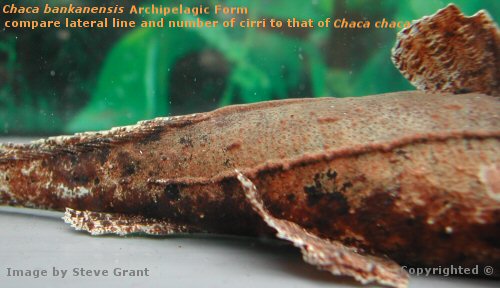
 Hamilton described the colour and pattern as “above clouded with green and black, and below with the latter colour: but all its colours are dirty and ill defined. The fins are spotted with black.”. See the original drawing from Hamilton (1822). Some aquarists consider that you can easily tell C. chaca from the other species by the light tan colouration that we tend to see in most specimens (but which doesn’t match the colour given by Hamilton!), but also mainly the pattern. This is because (as you can see from the drawing from Hamilton) C. chaca usually has some spots or blotches on the body (see images). However, I recently came across a specimen of C. bankanensis which also has pale colouration, but also the spotting/blotching of C. chaca. Therefore it is important that aquarists use the other methods of identifying them discussed later, and not just rely on colour or pattern.

 The specimens pictured by me were imported direct from India. The bizarre specimen pictured by Anne Waal (which I have only tentatively identified as chaca) has numerous cirri on the head and body, some of them being very thick. Even though these appear to be (currently) technically the same species they differ greatly in: colour, the extent of the cirri or papillae on the head and body, and also the fact that Anne’s specimen has much more conspicuous cirri around the eye, than in my specimen and the one pictured by Ingo Seidel. However, its colour and pattern does match that given by Hamilton. The specimen was purchased as a C. burmensis
 by Anne from an aquarium shop, and at first glance its colouration appears reminiscent of C. burmensis. However, based on the great extent of the cirri on the head, and the fewer cirri along the inside fringe of the lower lip, I have tentatively identified it as a C. chaca.
Chaca bankanensis Bleeker, 1852
Chaca bankae Giebel, 1857 (emendation or mistake for C. bankanensis?)
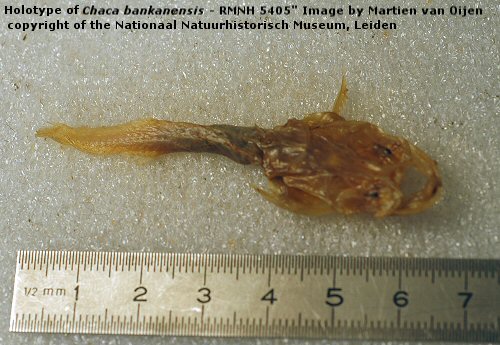
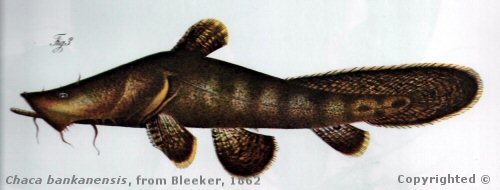
 Bleeker described this species based on one small (68 mm) specimen from the island of Bangka (which he misspelled Banka), in Indonesia, and this is where the species takes
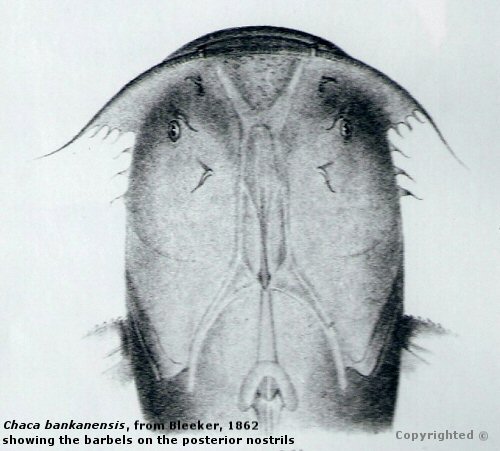
  its name (so it could have actually been called bangkanensis!). See exclusive images of the holotype (RMNH 5405), and the drawings from Bleeker (1862). The current distribution for the species is Peninsular Malaysia, the extreme southeastern tip of peninsular Thailand (Udomritthiruj, pers. comm., and Vidthayanon, 2004), Sarawak, Indonesia (Kalimantan, Sumatra, Bangka, Belitung, and possibly Java - Tandjong), and possibly Singapore (Bukit Merah). This species will reach at least 20 cm SL.
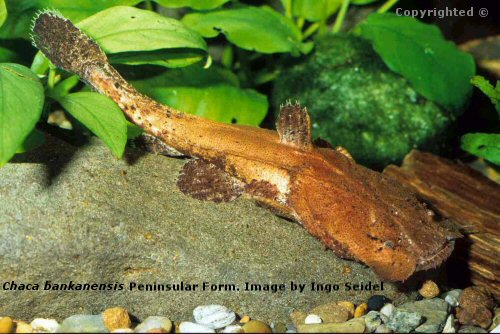
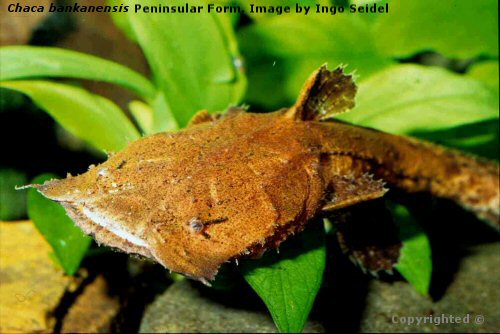
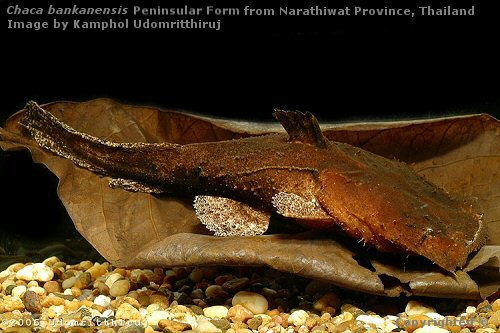
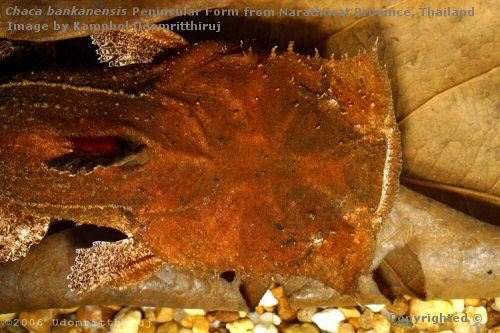
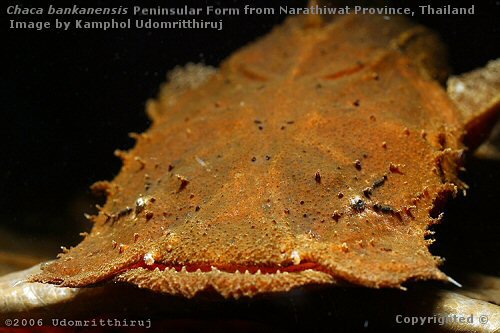
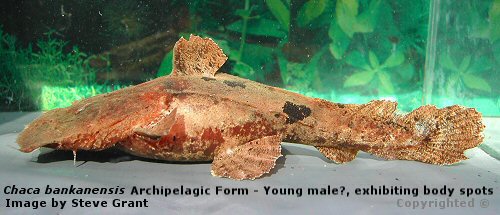
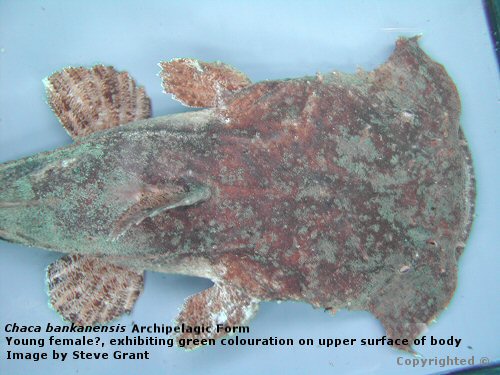
 The colour of this species can vary from reddish brown specimens, which are usually the ones from Singapore, Thai or peninsular Malaysia (see images by Ingo and Kamphol) which I will call the Peninsular Form; or some specimens from the remaining localities (which I will call the Archipelagic Form) can be brown in varying lighter or darker shades; some specimens having greenish patches, and very few having blackish blotches (similar to C. chaca).
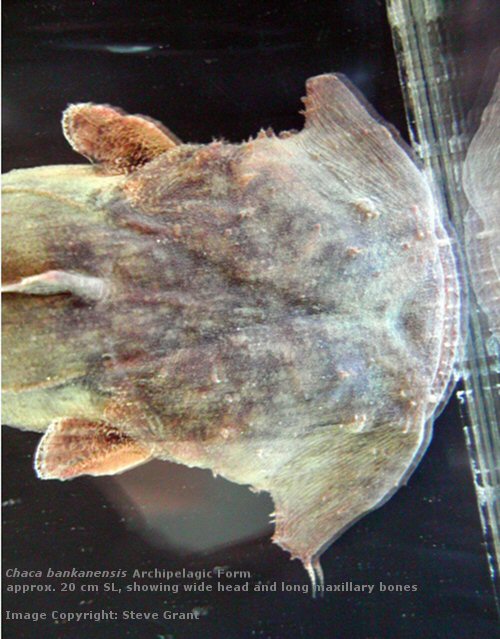
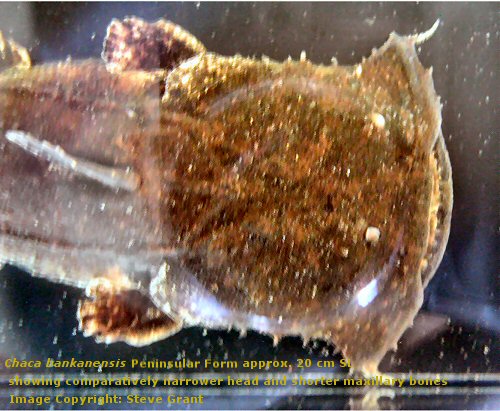
It is possible that the peninsular Malaysian, Thai, and Singapore specimens represent  a new species or sub species in their own right. I have noticed that some Archipelagic Form specimens have much broader heads when compared to others (and also when compared to all Peninsular Form specimens), and this is due to much longer maxillary bones. I thought that this may be a clue to differences that may warrant a different species or subspecies for the Peninsular Form, as this is one of the differences given by Brown & Ferraris (1988) to differentiate their (then) new species. This was because I had seen adult (19 cm SL) specimens from different imports, of equal sizes of bankanensis of both forms, which had much different sized head-shapes due to the relative size of the maxillary bones. However, I have since f
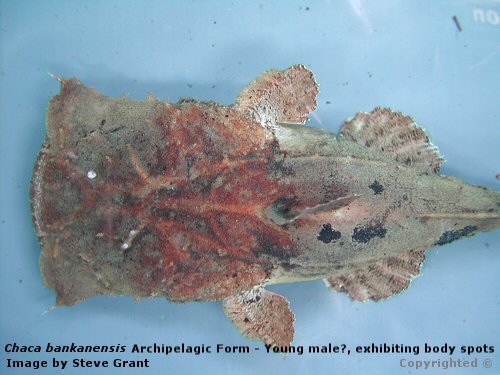
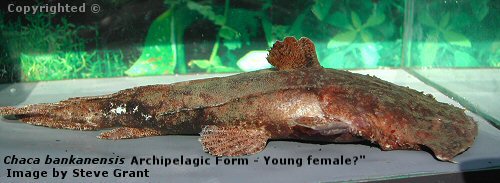
 ound this difference in small specimens of equal size from the same import of the Archipelagic Form (see images). However, none of the Peninsular Form that I have seen have the broad head. My views are then that these differences are not just related to age / ontogeny / size, or in their own right differences in species or sub species, but are probably differences in the gender of the fish where the Archpelagic Form is concerned. Again, however, it does not rule out the possibility that the Peninsular Form is different to the Archipelagic Form, especially when none of the Peninsular ones I have seen have the broad heads, as do some of the Archipelagic Form. As well as this difference, and the difference in colour, the Peninsular Form seems to have much smaller nasal barbels, than the Archipelagic
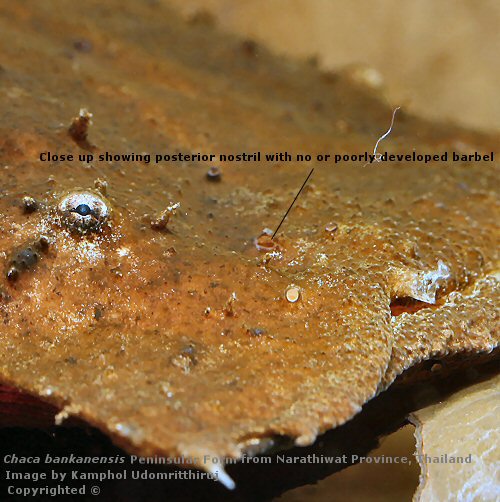
  form. In some specimens Peninsular Form (particularly from Toh Daeng Peatswamp, Narathiwat Province, Thailand), there doesn’t even appear to be a barbel, just a small flap of skin. This of course needs more work on it than I can give, but don’t be surprised if we get a fourth species of Chaca, or a new sub species described for the Peninsular Form.
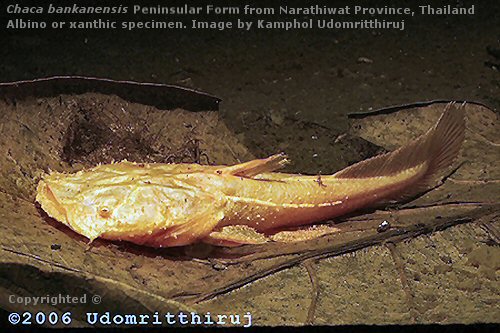
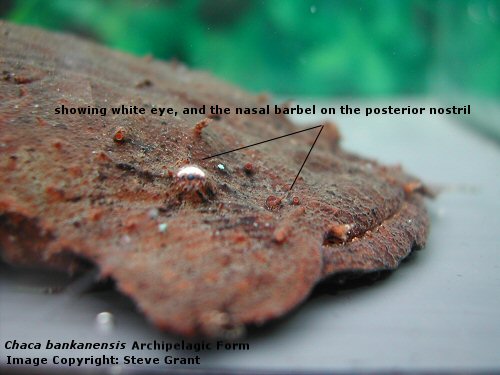
As reported in Ferraris (1991), some specimens have white eyes, (see image). The white appears to be confined to upper part of the cornea, and/or sclera, and not to the iris, therefore I do not think that this makes them blind. One of Kamphol’s photographs appears to show an albino or a xanthic (yellow) specimen.
Chaca bankanensis Peninsular Form from Narathiwat Province, Thailand
|
| | |
Chaca bankanensis Archipelagic Form
|
| | |
Chaca bankanensis Archipelagic Form
|

Young female?, exhibiting green colouration on upper surface of body
| 
Compare lateral line and number of cirri to that of Chaca chaca
|
Chaca bankanensis Archipelagic & Peninsular Form
|

Archipelagic form: approx. 20 cm SL, showing wide head and long maxillary bones
| 
Peninsular Form: approx. 20 cm SL, showing comparatively narrower head and shorter maxillary bones
| 
Archipelagic Form, showing white eye, and the nasal barbel on the posterior nostril
|
 Chaca burmensis Brown & Ferraris, 1988
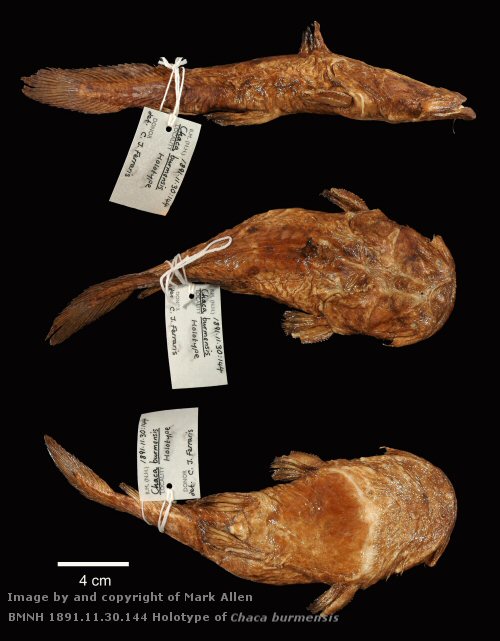
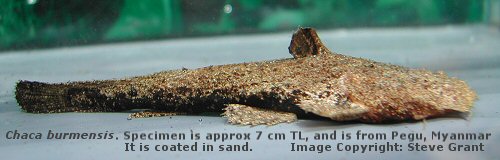
This species was described on the basis of four specimens in the Natural History Museum, London (see image of holotype). The largest type specimen is 20.35 cm, and they originate from the Sittang River, Burma (Myanmar). Obviously the species takes it’s name from Burma.
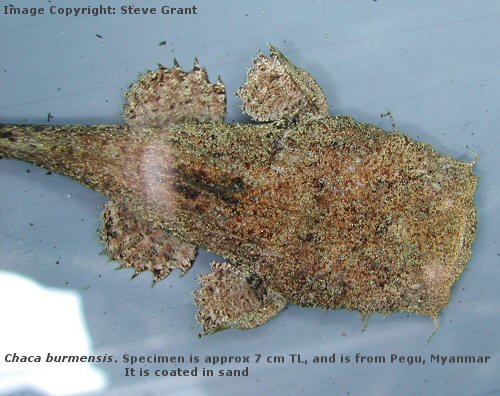
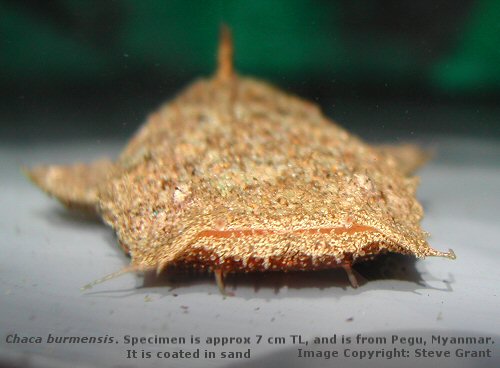
The shape, and outward appearance of this species are more similar to chaca than to bankanensis. It tends to be a dark / black base colour, mottled with light brown to tan colour, which can be the case for some C. chaca.
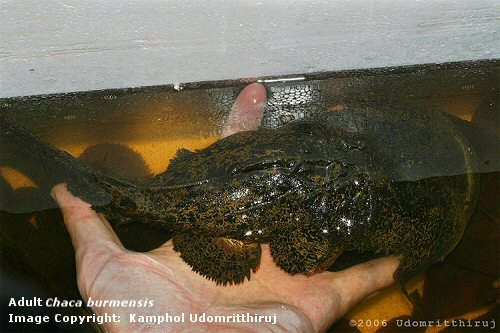
I have found that a small (approx. 7 cm TL) specimen from Pegu, Myanmar, killed two Hypostomus and almost killed two Bunocephalus species within a week of being put in their tank (which was approx. 12 inch by 10 inch). The Hypostomus died first, and at the same time the Bunocephalus started to develop open sores/burns in their skin and were hanging in upper water, but within a day of removing the burmensis and doing a 25% water change, they quite obviously started to pull round and return to normal. I considered whether it was the water parameters crashing, but the burmensis was absolutely fine, so I consider that it was releasing a poison into the water. Roberts (1982) states that there is an axillary (pertaining to the axilla
- literally the ‘armpit’, so in fishes, near the junction of the pectoral fin and the pectoral girdle, more specifically the cleithrum - Diogo et al 2004) pore in all Chaca’s but there was no evidence to show that it
 secreted a poison. Based on my observations I would guess that it does. He does state that earlier authors had written that the “natives” consider its flesh poisonous, although this report probably relates to bankanensis. Ferraris (1991) reports that certain feeder fish tend to die if not eaten, and in the early 1990’s in the Catfish Association of Great Britain magazine, I also reported this in a tank of chaca and bankanensis that I had.
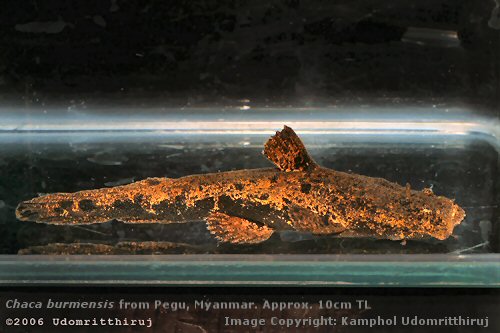
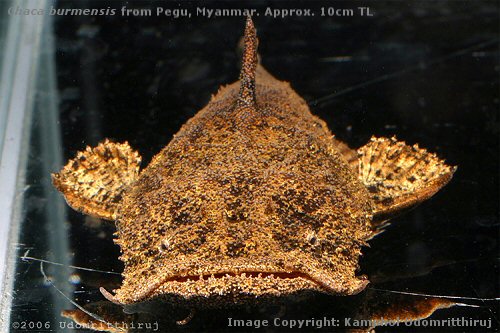
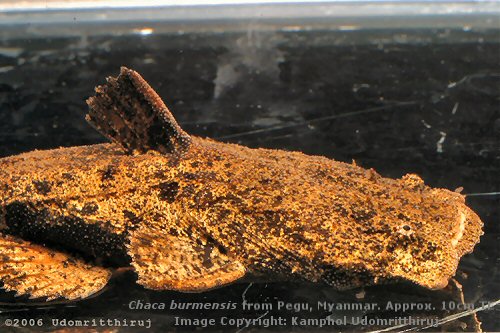
Kamphol Udomritthiruj (who exported the burmensis specimens pictured), has seen many specimens from Pegu, Myanmar. He informed me that he has witnessed burmensis curling the maxillary barbels to lure prey.
| Chaca burmensis from Pegu, Myanmar |
| | |
| Chaca burmensis from Pegu, Myanmar |

Specimen is approx 7 cm TL and is coated in sand
| 
Specimen is approx 7 cm TL and is coated in sand
| 
Specimen is approx 7 cm TL and is coated in sand
|
Differentiating the species
As mentioned earlier, colour and/or pattern alone is not a reliable indicator. Ferraris & Brown give some characters, but some of them can only be accurately used by utilising dead specimens and having knowledge of their anatomy (for which Diogo et al 2004 is useful).

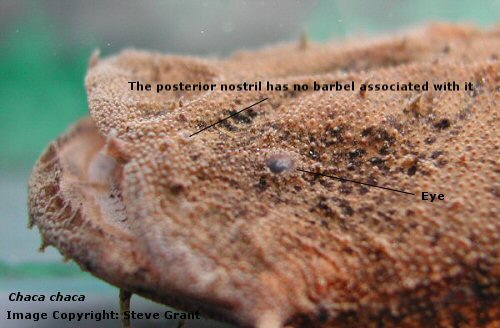
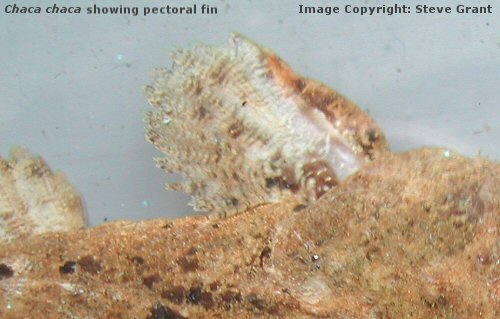
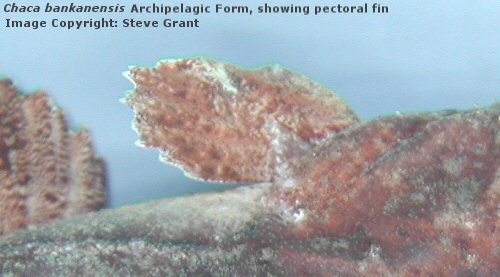
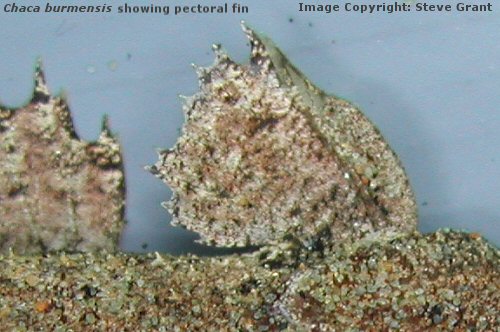
 Roberts visually differentiated C. chaca from C. bankanensis by the fact that C. chaca has 5 soft pectoral fin rays, versus 4. This can quite easily be seen if you look at the fish from above (see images), even without counting the rays you can see the different shape and relative size of the fin. Unfortunately burmensis can also sometimes have 4 rays, so the number of rays themselves are not indicative. The first indicator to use then, is to look for the tiny barbel on the rim of the posterior nostril (see image). C. chaca and burmensis do not have this, but unfortunately some Peninsular Form bankanensis don’t either, so if the fish has no posterior barbel, also then look at the shape of the pectoral fin when viewed from above. If it has a posterior nostril barbel, or the shape of the fin is that in the image above, you have a bankanensis. There are some other minor visual differences that are sometimes quoted, but I find it more reliable to use the ones I have given.
| Chaca chaca | Chaca bankanensis Archipelagic Form | Chaca burmensis |

Chaca chaca showing pectoral fin
| 
Chaca bankanensis Archipelagic Form, showing pectoral fin
| 
Chaca burmensis showing pectoral fin
|
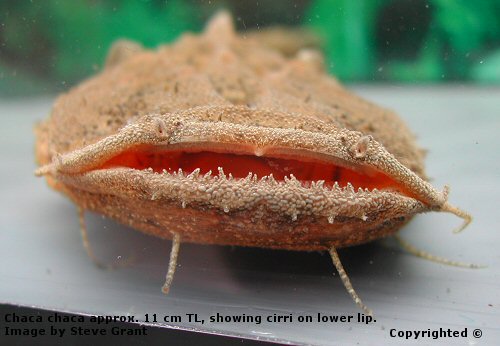
Differentiating chaca from burmensis using the naked eye is not as easy. Most of the differences listed in Brown & Ferraris use information inaccessible for aquarists using live fish. The number and extent of cirri is very variable in chaca, so although burmensis appear generally to have less, some chaca do also. C. burmensis tend to have a blacker base colour, but again this can be seen in chaca also. Brown & Ferraris state that “On the head, flattened flaps of skin, usually branched at the tip, occur laterally in the region of the cheek and opercle. None is found along the dorsal surface of the head or immediately posterior to the eye, as in C. chaca”. However, in some C. chaca, there aren’t any flattened flaps of skin on the head, or associated with the eye either (although there are cirri, but there are also some cirri in burmensis). The easiest way I have found to differentiate them using live specimens, is to look at the number and relative size of the cirri along the inner edge of the lower lip. In the C. burmensis I have seen, they usually number around 10 or 11 small cirri, and they don’t tend to have them near the corners of the mouth. In the C. chaca that I have seen, they tend to number at 14+ and tend to be relatively longer and/or thicker.
![[uNGu]™](https://blogger.googleusercontent.com/img/b/R29vZ2xl/AVvXsEgrPnhQswWH1n3co_BH9h53yVB4bM90uN-8zYlArwsG5kGjTCPGH7df0Y3uZofyDG2x9zRWH_wjTJ8NDmxsO-H3eYm9EXels8TVpJLKCth08DpTMXgxDvj_5BJCNRK0xall6aKLawXkQEER/s1600-r/Ungu_long.JPG)


 Family
 TEXTAREA_ID





 TEXTAREA_ID


 Postingan


