THOUSANDS OF FREE BLOGGER TEMPLATES
testing

Sabtu, 12 Juni 2010

[uNGu]™ Fish : Channa gachua - Dwarf snakehead, Brown snakehead

<I>Channa gachua</I> juvenile<I>Channa gachua</I> juvenile
Channa gachua juvenileChanna gachua juvenile
© JJPhoto© JJPhoto

Family

Channidae

Distribution

Sri Lanka, Indonesia (Bali), India, China, Thailand, Iran, Pakistan, Bangladesh, Myanmar, Cambodia,

Habitat

Maximum Standard Length

10" (25cm), but usually smaller in aquaria.

Minimum Tank Size

36" x 12" x 12"

Tank Setup

A densley planted aquarium with lots of hiding places and some floating plants is best for this fish. The tank must be well-covered as these fish are very good jumpers.

Temperature

72-79F (22-26C)

pH Range

6.0-7.0

Hardness

5-15

Diet

Carnivorous and enjoys live foods but adapts well to frozen food such as prawns, bloodworm and mussel in captivity. Will not accept dried foods.

Compatibility

Can be kept with other species of a similar size and nature but will predate on smaller fish. Can be maintained as a pair or species group in a larger aquarium.

Sexual Dimorphism

Females have rounder bellies. Males exhibit greater colouration in the dorsal, anal and caudal fins.

Breeding

Fairly easy. Mouthbrooding eggfeeder.

Notes

If you wish to breed Channa gachuabuy a group and allow a pair to form naturally as this species mates for life. Water parameters are not massively important but avoid extremes. Mating occurs in a similar fashion to anabantoids, with the pair sharing an embrace during which the eggs are released and fertilised. For several days prior to the act itself the fish will be seen in close contact and may share mock spawning embraces. After the eggs have been released they float to the surface where the male takes them into his mouth. The young are released after 3 days and the parents follow them around the aquarium guarding them. The female feeds her brood using "feeder eggs". These are infertile, non-floating eggs which she expels at regular intervals over the first month of the young's life. It is thought that this strategy ensures the fry remain well-fed in the nutrient-deprived waters in which these fish are often found in nature.

This is the most widely distributed channa species and it's range stretches over a huge area of Southern Asia, from Iran to China. It is found in many diverse habitats, from mountain streams to polluted ponds. It has even been recorded in tidal waters and in the hot springs of Kanniya, Sri Lanka, where water temperatures ranges from boiling to freezing in the space of 600 square feet! This hardiness coupled with the ability to cross land when it is wet has probably contributed to its distribution.

Contrary to some reports all Channa gachuado possess ventral fins. It also appears that several different species are currently being referred to as gachua as it has been found that all the different variants of this species have differing genetic backgrounds. Until the species is revised they are all Channa gachuahowever. 

Minggu, 06 Juni 2010

[uNGu]™ Fish : Tiger Fish , Datnioides /Datnoids

Tiger Fish , Datnioides /Datnoids


Types of Tiger Fish
There are many types of tiger fish, all of them have their own unique beauty.

Siamese Tiger Fish aka 'Tai Guo Hu', Wide Bar Datnoid, ST
( Datnioides Pulcher )
Indonesian Tiger Fish 'In Ni Hu', Indonesian Datnoid, IT
( Datnioides Microlepis )
Northern Thailand Tiger Fish, Thin Bar Datnoid, NTT
( Datnioides undecimradiatus )
New Guinea Tiger Fish, New Guinea Datnoid, NGT
( Datnioides Campelli )
American Tiger Fish, Silver Tiger, Silver Datnoid, AT
( Datnioides Quadrifasciatus )

Differentiating Tiger Fish
The most easy way to differentiate the different tiger types is by the different markings on the body and tail. New Guinea Tiger Fish and American Tiger Fish is the easiest to differentiate because they are quite different.

New Guinea Tiger Fish does not have straight and clear lines where the black stripes contrast with the golden body. The differentiation is wavy and 'flowery'.

American Tiger Fish has a more silverish body than all the rest of the Tiger Fishes.

The tricky part is differentiating between Siamese Tiger Fish and Indonesian Tiger Fish. To the untrained eye, they both look the same! The tell-tale sign is the number of stripes on the body. If the body has four black stripes, then it is an Indonesian Tiger. If the body has three black main stripes (discounting the stripes at the eye and tail), then it could be a Siamese Tiger or an Indonesian Tiger. In this case where the body has three black stripes, the differentiation in the marking on the tail. If you look at the thinest part of the tail that joins the tail fins to the bofy, you will find 2 small strips. If this two stripes is the same thickness, it is Indonesian Tiger. If the inside stripe is distinctly larger than the outer one, it is Siamese Tiger.

As for Northern Thailand Tiger Fish, their stripes are thinner and more spaced out than Siamese Tiger Fish. Often, their golden tone is also not as gold.
Tiger Fish Behavior
All tiger fish will turn unstable and blackish when stressed. This can be due to water condition, space constraints or bullying by other fish (even of the same species). Being predatory, they should not be kept together with peaceful fish.

Water Conditions
Optimal pH: 6.5 to 7.5
If your tiger fish is constantly unstable (dark and discoloured) even if the water condition is prisitine (no detectable ammonia and nitrites with low nitrates) and there are no fishes terrorising it, you may want to adjust the water salinity. Some tigers prefer freshwater while others prefer brackish water.
It is also best to have a 'landmark' for them such as a large piece of bogwood or rock that they can swim near to. In nature, they use their black against gold stripes to blend in with the light and shadows around plants, wood and caves.

[uNGu]™ Fish : New guinea tigerfish - Datnioides campbelli

New guinea tigerfish ( common name )
Datnioides campbelli ( fish name )
  • Maximum size in aquariums (min-max): 30 - 40 cm ( 11.81 - 15.75 in )
  • pH of water: 7 - 8
  • Water hardness (dGH): 15 - 25 °N
  • Recommended temperature: 23 - 26 °C ( 73.4 - 78.8 °F )
  • Compatibility (temperament to it's family): aggressive (read this answer)
  • Compatibility (temperament to other fish species): aggressive to smaller (read this answer)
  • Place in the aquarium: Middle levels
  • The way of breeding: Spawning
  • Fish origin: Oceania
Information about care
Food and feeding
Highly carnivorous, they prefer to consume live foods but can be trained to accept frozen foods as well. They will accept whitebait, cockles, mussels and shrimps. Beef heart will be taken as well but siphon out any that is not eaten as it will spoil the water.

Origin
Asia; these fish are found in Indonesia and New Guinea.

Sexing
There are no visible differences between the sexes.

Breeding
As of yet, there are no reported cases of this fish breeding in the aquarium.

Lifespan
The expected life span for this fish is 5-8 years.

Short description
This species of Datnioid is very rarely see in the fish keeping hobby, because of this they will demand higher prices. They are best kept as a single specimen in the tank as they can grow up to 18 inches in length. Provide them with plenty of open swimming spaces and use dimmed lighting.

Juveniles are peaceful towards each other, however adult specimens may be very aggressive.

Pictures
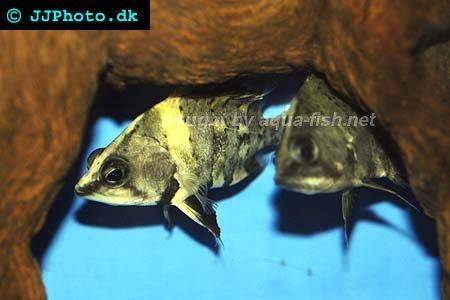
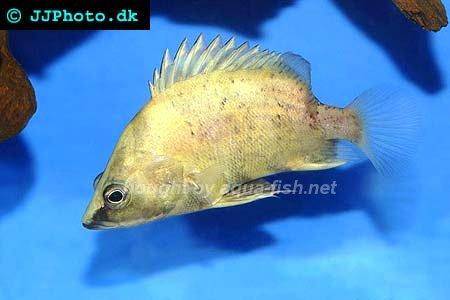
Bought by aqua-fish.net from jjphoto.dk.

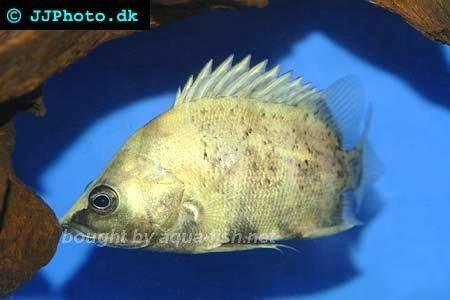
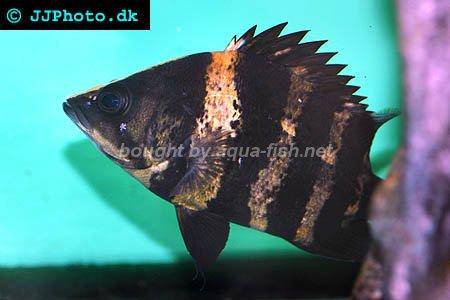
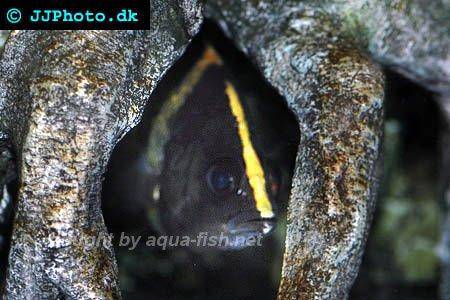
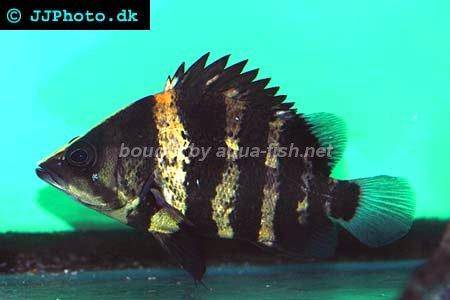
New guinea tigerfish, picture 1 New guinea tigerfish, picture 2 New guinea tigerfish, picture 3 New guinea tigerfish, picture 4 New guinea tigerfish, picture 5 New guinea tigerfish, picture 6

Datnioides campbelli - New guinea tigerfish
Have this fish on your website too! Use our widget:
Datnioides campbelli
Latin Name: Datnioides campbelli;
Common Name: New guinea tigerfish;
Adult size is between 30 cm (11.81 inch) and 40 cm (15.75 inch);
pH should vary between 7 and 8;
dGH should be between 15 and 25;
Temperature should be between 23°C (73.4°F) and 26°C (78.8°F)
New Guinea Tigerfish; on Aqua-Fish.Net

[uNGu]™ Fish : Datnoid Tiger Fish

Scientific Names The genus Datnioides now contains the five species listed in the table below. Click here for some interesting illustrations that may help identify the various species.
 
Common Names
Scientific Names 
Maximum Length
New Guinea Tiger Fish,
New Guinea Datnoid
Datnioides campbelli 
13"
Indonesian Tiger Fish,  Indonesian Datnoid,
In Ni Hu
Datnioides microlepis18"
Silver Tiger Fish,
Silver Datnoid 

 
Datnioides polota
Note: quadrifasciatus is now considered to be a junior synonym of polota.
12"
Siamese Tiger Fish,
Wide Bar Datnoid, 
Tai Guo Hu
Datnioides pulcher16"
Northern Thailand Tiger Fish,
Thin Bar Datnoid
Datnioides undecimradiatus16"
Common Names
Scientific Names 
Maximum Length
 
 
Size 
We have seen Tiger Fish that are much longer than 18", perhaps as big as 30". So we do not really understand the sizes listed above. Perhaps the sizes listed are for wild caught fish, and the fish we saw were tank raised to a much bigger size.
 
Buy these Siamese tiger fish, yellow datnoid, for sale at AquariumFish.net, a retail tropical fish supplier. Here are two Black Barred Siamese Tiger Fish just like the Tiger Fish for sale in our facility. Click here for more about buying Siamese Tiger Fish and other wild tropical fish from us.
   
These 5" Black Barred Tiger Fish were sparring and quarreling with each other, as Tiger Fish often do, when this picture was taken.
 
Comments 
Black Barred Tiger Fish will quarrel and spar with each other and will eat any fish that can be swallowed, but Tiger Fish do not bother other species of fish that are too big to swallow. Tiger Fish grow fast to large sizes and eventually require very large aquariums. 
 
Siamese Tiger Fish are also called Black Barred Tiger Fish, Yellow Dats, Gold Dats, and Datnoids. 
For many years the word Datnoid has been commonly used to describe this fish. As far as we know, this is incorrect, and Datnoid is probably just a very common misspelling of Datnioides, which is the correct way to spell the name of the genus of this fish.
  
 
Picture of a Black and White Tiger Fish. Click on the picture to see a bigger image. Here is a Black and White Tiger Fish, Datnioides polota, which was formerly called Datniodes quadrifasciatus. Picture take in our facility. Click here for more about how to buy Tiger Fish from us.
 
 
Appropriate Home 
An aquarium with at least 50 gallons of water, and eventually a much larger aquarium with an exterior power filter with a BIO-Wheel, a maximum of 1/4 inch of gravel, and an aquarium heater adjusted to keep the water between 78 and 82 degrees F. Tiger fish do fine with or without aquarium salt in their water. Click here for more about Aquarium Salt. Click here for more about warm water aquariums.
 
Recommended Diet 
Tiger Fish are piscivors that eat feeder fish such as 2" long common goldfish.  
When Tiger Fish are small, they will eat Guppies, Live Black Worms, and Ghost Shrimp. Click here for information about Ghost Shrimp, and click here for information about Live Black Worms. Incidentally, we do not sell or ship Live Black Worms.  Click here for more information about feeding fish.
 
Compatibility 
Tiger Fish are best kept with other fish that are too large to be swallowed. Tiger Fish will quarrel with each other, so they are best kept one Tiger to an aquarium, unless the aquarium is very large. Tiger Fish are often seen in the same aquarium with large Oscars, large Pacus, large Tinfoil Barbs, Large Bala Sharks, and large Clown Knife Fish. Tiger Fish can also be kept with catfish that are too large and spiny to be eaten. For example, White Tip Shark CatsPictus Catfish, and Synodontis Catfish. Click here to read more about several other groups of compatible fish.
 
Size and Life Span 
Tiger Fish grow fast to be 24" and sometimes larger. They live for 10 years and sometimes longer.

[uNGu]™ Fish : Four-Barred Tigerfish (Datnioides polota)

Alternative names

Four-Barred Tigerfish, Four-Banded Tigerfish, Barred Tigerfish, Four-Banded Triple-Tail

[edit]Synonyms

Datnioides quadrifasciatusChaetodon quadrifasciatusCoius binotatusCoius polotaCoius quadrifasciatusDattnioides quadrifasciatusLobotes hexazona
Four-Barred Tigerfish
SpeciesDatnioides polota
FamilyDatnioididae
DifficultyModerate
Min. Tank Size
100 US Gallons (378.5L)
Size
25-30 cm (9.8-11.8")
sg1 - 1.015
pH6.6 - 7.6
Temp.
22 -26 °C (71.6-78.8°F)
Water Hardness
6-16 °d
Stocking Ratio1:1 M:F
AvailabilityRare
Diet
Life Span
8-12 years
Habitat